Beyond awareness
Building Africa's next generation of climate champions
Young Africans already understand the climate crisis; many live it. The gap is the pathway from awareness to skills, resources, responsibility and paid work.



Watch the full conversation
The numbers behind the conversation
Young Africans who join the labour force each year, while about three million formal jobs are created annually.
(African Development Bank)New direct green jobs that could be created across Africa by 2030.
(FSD Africa (2024))Share of grants from major climate foundations, 2022–2024, that supported youth-led climate justice initiatives.
(Youth Climate Justice Fund and ClimateWorks (2025))Share of new national climate plans (NDCs) that include information on children and youth, up from 61%.
(UNFCCC, 2025 NDC Synthesis Report)Young people are not short of concern. In a survey of 450,000 young people across Africa and Europe, most felt responsible for tackling climate change and wanted a role in the green transition, and nearly half named lack of capital and resources as the biggest barrier. The session asked what sits between that awareness and meaningful work.
Willing, but under-resourced
Awareness is the first step, not the last.
Nina Mbah, impact media producer and co-founder of African Climate Stories, argued that awareness on its own changes nothing. Many young people want to act but are discouraged by the scale of the problem, or by comparing themselves with people who already have large platforms. The task is to break a problem down into the smallest action a person can take next, because things that become significant usually start very small.
"Awareness on its own, it does not really change anything."
— Nina Mbah · African Climate StoriesPick your struggle, then build on your strength.
The climate field is crowded with researchers, scientists, government, policy and finance, and its jargon can make young people feel unqualified to propose solutions. Nina's advice was to decide early which part of the field suits you, rather than imitating what looks impressive, especially when money and other resources are scarce.
"We start by saying, pick your struggle, because it's a very wide sector."
— Nina Mbah · African Climate StoriesYoung people are not waiting for a perfect definition of green jobs.
Baliqees Salaudeen-Ibrahim, CEO of Green Republic Farms, began with a question: what is your own definition of a green and inclusive job? Farming is still widely seen as a poor man's job. Yet a decade ago, young activists treated recycling and upcycling as community projects; today some of those efforts have grown into recycling companies that train women and create employment.
"We're not necessarily waiting for a perfect definition of green jobs."
— Baliqees Salaudeen-Ibrahim · CEO, Green Republic FarmsFrom microphones to mandates.
A'aron John put the question directly: being consulted is not the same as having responsibility or power. Olumide Idowu, co-founder and executive director of ICCDI Africa, agreed. Young Africans have become very effective at raising awareness, but a climate champion should also be trusted to design projects, manage resources, engage communities, collect data and demonstrate results. Young people learn leadership by actually leading.
"We need to move from giving young people microphones to giving them mandates."
— Olumide Idowu · ICCDI AfricaUniversities should produce climate problem solvers, not only climate graduates.
Olumide traced the problem back to childhood, when few children tell their parents they want to be farmers. Climate education, he argued, should start in primary school and be practical: children should learn how climate affects the food they eat, the water they drink and the flooding in their communities. At university, every discipline, from law to engineering to agriculture, should teach how climate change affects that profession and how the profession can respond.
"When we have a chemistry lab and a physics lab, we should have a living laboratory where students work on climate problems."
— Olumide Idowu · ICCDI AfricaThe gap is access, not awareness.
Salem Mihindeou AYENAN, an Africa Regional Committee Member at the Youth Climate Justice Fund, has reviewed applications from thousands of youth-led climate justice groups through its work. Many understand the crisis because they live it. What they often lack is the institutional history, grant-writing capacity and financial systems that funders expect, and receiving a grant brings its own demands: budgets, records, monitoring and reporting. Funding can be part of how an organisation builds those systems, if young people are trusted as actors.
"Youth-led climate justice groups should have direct access to resources, and should be trusted as actors, not simply treated as beneficiaries."
— Salem Mihindeou AYENAN · Youth Climate Justice Fund (YCJF)From clean-ups to building something real.
Asked what early experiences shaped her, Baliqees described volunteering from a young age and spending money meant for food on organising clean-ups. Over time she saw that clean-ups and tree planting were not enough, and that raising placards did not make decision-makers take young people seriously: they wanted to see innovation. Agriculture became her way to show what young people can build.
"I saw agriculture as a key entry point for me to be able to display my innovation when it comes to climate action."
— Baliqees Salaudeen-Ibrahim · CEO, Green Republic FarmsFor young people, institutions and funders
What is the smallest next action you could take on the climate issue you care about most?
Which strength do you bring that the climate field is missing: research, data, storytelling, organising or enterprise?
Where in your institution are young people consulted, and where are they responsible for delivery?
If you fund or run youth programmes, do you count how many young people you reached, or how many you enabled?
- Move from awareness to action. Break problems into small, concrete steps and help young people find where their strengths fit.
- Give responsibility, not only a platform. Trust young people to design, manage and account for real projects.
- Fund organisations, not only individuals. A funded youth-led organisation creates roles, skills and first jobs for others.
- Measure who you enable. Experience demonstrates capacity in a way a certificate cannot.
Connect learning to practice
- Link climate education to real work, not only to graduation (Salem)
- Build living laboratories where students tackle climate problems in every discipline (Olumide)
Create real entry points
- Bring young people into decision-making, not only consultation (Salem)
- Address the basics of food, clothing and housing that decide whether young people can take up climate work (Olumide)
- Invest in an environment that puts money in young people's hands, including through the circular economy (Olumide)
Recognise experience earned outside offices
- Count running organisations, managing projects and coordinating volunteers as professional experience (Salem)
Fund organisations and collaboration
- Invest in youth-led organisations, which create roles for others (Salem)
- Fund partners working on the same problem to build joint solutions, rather than separately (Baliqees, Nina)
- Measure success by how many young people are enabled, not reached (Olumide)
Start small and stay open
- Start with the smallest next step (Nina)
- Learn from those who have walked the road before, and be vulnerable to learning (Baliqees)
Nina Mbah
Impact Media Producer & Co-founder, African Climate Stories.Nina Mbah is an impact media producer advancing environmental sustainability and the green energy transition through storytelling and behaviour change.
linkedin.com/in/ninambahBaliqees Salaudeen-Ibrahim
CEO, Green Republic Farms.Baliqees Salaudeen-Ibrahim is an agricultural entrepreneur and sustainability advocate advancing climate-smart farming, food security and sustainable agriculture.
Olumide Idowu
Co-Founder & Executive Director, International Climate Change Development Initiative (ICCDI Africa).Olumide Idowu is a climate advocate and Executive Director of ICCDI Africa, advancing youth leadership, climate action and sustainability across Africa.
@OlumideIDOWUSalem Mihindeou AYENAN
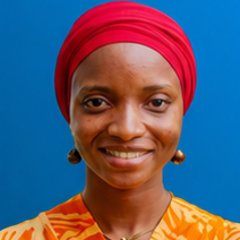
Africa Regional Committee Member, Youth Climate Justice Fund (YCJF).Salem M. AYENAN is an environmentalist and Africa Regional Committee Member at YCJF, engaged in youth-led climate justice across Africa.
A'aron John
Founder and Executive Director, CCAIE · ModeratorWatch the conversation
The full recording, with chapters and captions, and short clips from the session are published on CCAIE's YouTube channel.
Watch the full recordingyoutube.com/@CCAIE_SpacesQuotations are taken from the session recording and lightly edited for readability. Figures were checked against the sources listed here.
Sources
- African Development Bank (2016). Leaders underscore urgent need to create jobs for African youth. — afdb.org
- FSD Africa (2024). Research on green jobs in Africa: more than 3 million direct jobs by 2030.
- Youth Climate Justice Fund and ClimateWorks Foundation (2025). Youth Climate Funding Study. — climateworks.org
- UNFCCC (2025). 2025 NDC Synthesis Report. — unfccc.int
- African Union, European Union and UNICEF (2021). #YourVoiceYourFuture. — unicef.org
- Session recording and transcript, Climate Readiness Series, 25 September 2026.
- Photo of Salem Mihindeou AYENAN: credit Salem M. AYENAN.